
Grants
Tackling environmental threats
Salmon farming economic analysis
£30,000 awarded
Grantee: WildFish and Sustainable Inshore Fisheries Trust
Duration: 12 months (January – December 2025)
Background
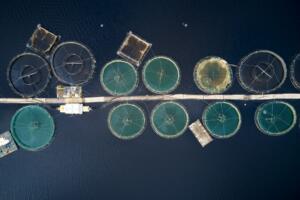
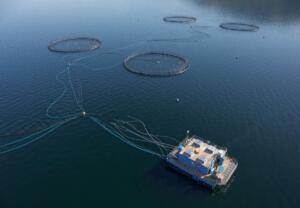
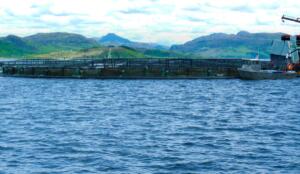
Salmon farming is a widespread industry throughout the Highlands and Islands, with over 200 farms dotted along our coastlines and sea lochs. The industry is controversial for a number of reasons, with particular concerns on its environmental impact raised by numerous local communities living beside these farms.
The billions of fish, located in pens just beneath the surface, release their waste into the surrounding environment. This has been estimated to be the equivalent of the entire Scottish populations’ untreated sewage being dumped into the sea.
The effects on Scotland’s fragile wild salmon populations are also thought to be significant. The open net pens attract sea lice infestations, which, aside from resulting in high mortality rates on farms, can have disastrous consequences for migrating wild fish populations.
As is the case with all industry, the Scottish Government has a responsibility to regulate, monitor, and enforce legislation to manage impacts on the surrounding environment.
But the past decade has seen a failure to do this. An ongoing inquiry scrutinising the Government’s management of the industry has repeatedly criticised the industry and Government for their slow progress to improve regulation and address environmental concerns.
In 2025, this was exemplified by an escape of over 75,000 fish on Loch Linnhe. Impacts on wild fish and the wider marine environment were dismissed by the Government and no fine or other regulatory action was taken.
The primary reason for continued Government support is the economic contribution made by the salmon farming industry at both local and national levels. In remote rural areas with increasing rates of depopulation, the industry is seen as a crucial year-round employer. At the Scotland-wide level, salmon is the UK’s largest food export.
These arguments are supported with impressive figures, such as “the activities of those involved in the sector supported an economic impact worth £953m Gross Value Added (GVA), and 10,850 jobs across Scotland in 2024 “.
However, many disputed that these claims were exaggerated, primarily as they don’t take into account the potential negative impact on other industries.
In 2025, leading marine conservation charities WildFish and Sustainable Inshore Fisheries Trust commissioned a report to examine this in more detail.
The Project
The 6-month long research project was led by Dr Andrew Moxey, the former Chief Agricultural Economist at the Scottish Government and Prof Angela Tregear, from the University of Edinburgh. Using Skye and Lochalsh as a case-study, the research set out to estimate “underreported negative economic effects arising from salmon farming.”
The report involves a comprehensive literature review, before outlining the current salmon farming situation in Skye and Lochalsh. It then sets out the ‘headline figures’ – economic claims made by the industry – before scrutinising the numbers using Government best-practice approach to economic assessment.
In summary, they find that “Headline estimates of the economic impacts of Scottish salmon exaggerate economic benefits by focussing on gross rather than net effects and disregarding counterfactuals.”
“In Skye and Lochalsh, salmon farms are estimated to account for c.137 jobs. Of these, stakeholder testimony suggests that c.9% to 28% may not be net additions to local employment due to displacement effects.”
For example, interviews with a range of stakeholders indicated that salmon farms displace other marine industries, such as mussel farming, low-impact fishing, and marine tourism.
The study also scrutinised claims of community benefit sharing, highlighting that the salmon farm companies:
- Are often owned by larger groups head-quartered overseas, diminishing retention of profits locally
- Receive millions of pounds in grants from Governments, which partially offsets the tax they pay
- Pays tax directly to centralised Government, therefore bypassing local authority funds
- Donates a relatively modest amount to community causes when total revenue and profit is taken into consideration
- Bypasses local democratic processes and accountability by deciding independently which causes to support
- Are exempted from Non Domestic Rates, thereby reducing their contribution to the localities they operate in
Finally, a series of recommendations are made, in particular that the Scottish Government adheres to economic best practice and improves data collection and provision.
Impact
Since its publication, the report has:
- received wide coverage in Scotland’s national STV News 011225, local West Highland Free Press 121225 and industry media Fish Farmer 180126
- Raised public awareness and engagement with the issue on social media – eg Facebook
- been the subject of continued correspondence with the Scottish Government Letter-to-Cabinet-Secretary
- been sent to all MSP members of the Rural Affairs & Islands Committee and referenced in submissions to the Committee’s extended inquiry on salmon farming.
- Provided valuable context for ongoing media engagement about the impacts of salmon farming
Looking forwards, Wildfish and SIFT intend to continue to promote the report’s key message that the economic benefits of open cage salmon farming are widely exaggerated by both the aquaculture industry and the Scottish Government. Wildfish and SIFT intend that this will become, for the first time, a key part of the accepted narrative about open cage salmon farming, alongside more familiar concerns regarding environmental impacts. To that end key findings from the report will be highlighted when briefing members of the Scottish Parliament’s Rural Affairs & Island Committee during its ongoing inquiry into salmon farming in Scotland.
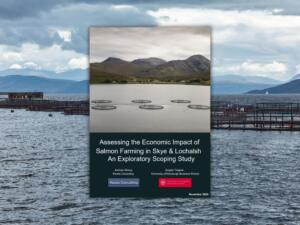
The final report can be downloaded from the Wildfish website here