Grants
Restoring ecosystems
Collecting native oyster spat
£13,400 awarded
Grantee: University of Glasgow
Duration: 10 months (January – October 2026)
Background
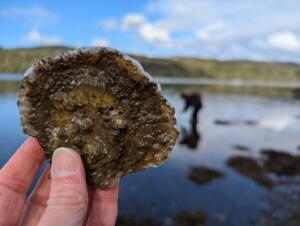
Native oyster restoration has considerable benefits to the marine environment, improving the water quality and biodiversity of coastal systems while also engaging people from communities with their local shorelines. The interest in delivering restoration projects across the Highland & Islands region is gaining momentum, through projects led by community groups such as Seawilding and CAOLAS. However, there is currently a major bottleneck faced by all of these projects; demand for juvenile oysters currently exceeds the production that is possible at the few hatcheries growing native oyster.
The Project
Led by the University of Glasgow, this project aims to design an alternative supply of native oysters in order to boost restoration efforts by community groups in the Highlands and Islands.
In order to reproduce, oysters release their microscopic larvae into the sea before those larvae settle onto hard surfaces and grow into tiny oysters known as ‘spat’. In both the freely drifting larval stage and the settled spat stage, oysters are extremely prone to getting eaten by predators but are very abundant. This project aims to collect and grow larvae into spat at locations where there is an abundance of native oysters, in order to improve the number of oysters grown on-site. This will involve the adaptation of existing ‘aquaria units’ owned by the University, with a series of trials testing the effectiveness of various ‘spat collectors’ using different materials.
The project will involve community groups in the Mull area, such as CAOLAS and Mull and Iona Community Trust, who are at different stages of native oyster restoration efforts.
This pilot initiative has potential to diversify and improve the resilience of native oyster supply, and thus improve the long term effectiveness of marine restoration efforts.